You’re driving home from work, and you pull into your driveway. Suddenly, you realize you don’t remember the last ten minutes of the trip. The turns, the traffic lights, the familiar landmarks—all a blur. You were on autopilot. You were aware you were driving, but you weren’t mindful of it. This common experience gets to the heart of a crucial distinction many of us miss in the conversation around mental clarity: the difference in mindfulness vs awareness.
They sound like synonyms, often used interchangeably in articles and wellness apps. But understanding how they differ is the key to unlocking the full power of both. One is a broad, panoramic view of your world; the other is a focused, high-definition close-up.
Getting this right isn’t just about semantics. It’s about choosing the right mental tool for the right job—whether that’s navigating a difficult conversation, breaking a bad habit, or simply enjoying your morning coffee without your brain planning the next ten hours of your day.
Pressed for time? Here’s the core of what you need to know about mindfulness vs. awareness.
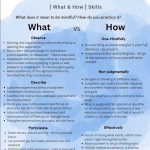
Awareness is the ‘What’. It’s the broad, always-on capacity to perceive your inner and outer world. It’s knowing you feel anxious or hearing the rain outside. It’s the state of being conscious.
Mindfulness is the ‘How’. It’s a specific, active practice of paying attention. It’s deliberately focusing on your breath, the sensation of anxiety in your chest, or the sound of each raindrop—all without judgment.
Focus: Awareness can be broad and unfocused, like background noise. Mindfulness is intentionally narrow and focused on the present moment.
Intention: Awareness is often passive—it just happens. Mindfulness is always intentional—you have to decide to do it.
Judgment: Awareness can include analysis and judgment (“Ugh, this anxiety is ruining my day”). Mindfulness is fundamentally non-judgmental (“I notice the feeling of anxiety is present”).
So, What’s the Real Difference?
Think of it like this: Awareness is the entire room you’re in. Mindfulness is the flashlight you use to deliberately illuminate one specific part of that room.
You are always aware of the room to some degree—its temperature, the ambient light, the furniture in your periphery. But you only become intimately familiar with the grain of the wooden table or the title of a book on the shelf when you point your flashlight directly at it.
Awareness: Your Operating System of Consciousness
Awareness is your mental baseline. It’s the continuous, often passive, stream of information your brain processes about your internal and external environment. It’s the capacity that lets you know:
Internal States: “I’m feeling tired,” “I’m thinking about that deadline,” or “My shoulder is tense.”
External World: “The traffic light is red,” “My phone is buzzing,” or “Someone is speaking.”
This state is running in the background all day, every day. It can be analytical and evaluative. Your awareness might notice you’re feeling anxious and immediately launch into an analysis: “Why do I feel this way? It must be that meeting tomorrow. I need to prepare more.” The goal of awareness is often to uncover patterns and understand things on a cognitive level.
Mindfulness: The Practice of Paying Attention
Mindfulness, on the other hand, is a specific skill you cultivate. It’s the active process of aiming your awareness at one thing in the present moment, on purpose, and without passing judgment.
It’s about stepping out of the stream of analytical thought and simply observing. Instead of analyzing your anxiety, you would use mindfulness to:
Direct Attention: “I will focus on this feeling of anxiety.”
Observe Sensations: “I notice a tightness in my chest and my heart is beating quickly.”
Withhold Judgment: “It’s not good or bad. It’s just a sensation. I will watch it without needing to fix it.”
Mindfulness isn’t about emptying your mind; it’s about paying close attention to what’s already there with a curious and accepting attitude. The goal is not to uncover why, but to simply be with what is, which paradoxically leads to a sense of release, or “letting go.”
A Side-by-Side Comparison: Focus, Judgment, and Intention
To make it even clearer, let’s break down the primary distinctions in a more structured way.
Feature
Mindfulness
Awareness
Focus
Narrow & Internal. Directed at a specific present-moment experience (a breath, a sound, a feeling).
Broad & Expansive. Can be internal or external; often unfocused and running in the background.
Judgment
Non-Judgmental. The core principle is to observe without labeling experiences as “good” or “bad.”
Can Be Judgmental. Often involves analysis, evaluation, and problem-solving (“This is a bad habit”).
Intention
Active & Deliberate. A conscious choice to pay attention in a particular way. A mental workout.
Passive & Continuous. The default state of being conscious; you don’t have to “try” to be aware.
Primary Goal
Letting Go. To accept the present moment as it is and release attachment to thoughts and feelings.
Uncovering. To understand patterns, make connections, and gain insight into your behavior and environment.
Imagine you feel a pang of anger during a meeting.
Awareness is the part of you that registers, “I’m angry.” It might immediately start a narrative: “He shouldn’t have said that. It was disrespectful. Now I have to figure out how to respond.” This is your brain’s problem-solving mode kicking in.
Mindfulness would be the choice to pause and turn your “flashlight” inward. You’d notice the anger without getting swept away by the story. “I feel a hot sensation in my face. My jaw is clenched. I observe the feeling of anger.” By simply observing, you create a small gap, giving you the power to choose your response rather than just reacting.
Better Together: How Mindfulness Sharpens Your Awareness
While they are different, mindfulness and awareness exist in a powerful, symbiotic relationship. You can’t have one without the other, and strengthening one automatically strengthens the other.
Think of mindfulness as going to the gym for your awareness. Each time you practice a mindfulness exercise—like focusing on your breath for two minutes—you are training your attention. You’re teaching your brain to stay where you put it, rather than being pulled away by every stray thought.
This regular training has a profound effect on your general, day-to-day awareness. Your “background” state becomes clearer and more high-definition. You start to notice things you previously missed:
You catch yourself mindlessly scrolling on your phone sooner.
You recognize the subtle physical cues of stress before you get overwhelmed.
You hear the nuance in a loved one’s voice, not just the words they’re saying.
This integrated state is the essence of what is often called mindful awareness, a powerful combination that allows you to remain broadly conscious of your surroundings while staying grounded in the present. In fact, many people find that Cultivating Mindfulness Awareness is the ultimate goal of their practice. This positive feedback loop—where mindfulness sharpens awareness and heightened awareness makes it easier to be mindful—is where real transformation happens.
Why This Matters: The Science-Backed Benefits
This isn’t just feel-good philosophy; the benefits of training your attention are backed by a growing body of scientific research. When you practice mindfulness to enhance your awareness, you are literally changing your brain and body.
Taming Your Stressed-Out Brain
Chronic stress keeps our bodies in a state of high alert. Mindfulness practices are proven to directly counter this. Research has found that consistent practice can lead to significant physiological changes. For example, one landmark study showed that an 8-week mindfulness program resulted in a 25% reduction in cortisol, the primary stress hormone. Practitioners also report feeling calmer and more in control, even in stressful situations.
Reshaping Your Brain for Resilience
Neuroscience research using fMRI scans shows that mindfulness can physically alter the structure of your brain. It’s been linked to an increase in gray matter density in areas associated with learning, memory, and emotional regulation. Simultaneously, it can reduce activity in the brain’s “default mode network” (DMN)—the part responsible for mind-wandering and that constant internal chatter. You’re not just managing your thoughts; you’re rewiring the machinery that produces them.
Sharpening Your Distracted Mind
In our hyper-stimulated world, focus is a superpower. Researchers estimate that the human mind can shift its attention up to four times per second. Without training, our focus is scattered and weak. Mindfulness is a direct antidote to this. By repeatedly bringing your attention back to a single point (like your breath), you strengthen your prefrontal cortex, the brain’s executive control center. This translates to better concentration, less procrastination, and improved performance on complex tasks.
Putting It Into Practice: Your Toolkit for a More Conscious Life
Knowing the difference is the first step. The next is integrating these concepts into your daily life. Here are simple, practical exercises you can start today.
Exercises to Build Your Mindfulness Muscle (The Flashlight)
These are short, focused practices to train your attention. Consistency is more important than duration.
The 1-Minute Breath Anchor: Three times a day, set a timer for one minute. Close your eyes (if you feel comfortable) and bring all of your attention to the sensation of your breath. Notice the feeling of the air entering your nostrils, your chest rising and falling. When your mind wanders (which it will), gently guide it back to your breath. That’s it.
The Body Scan: While lying in bed before sleep, bring your attention to the tips of your toes. Just notice any sensations—warmth, tingling, pressure, or nothing at all. Slowly move your “flashlight” up your body: feet, ankles, shins, knees, and so on, until you reach the top of your head. Don’t try to change anything; just observe.
Mindful Moments: Pick one routine activity a day to do with full, non-judgmental attention. It could be washing the dishes (feel the warm water, see the soap bubbles), drinking your tea (notice the aroma, the warmth of the mug), or walking to your car (feel your feet on the ground, notice the air on your skin).
Techniques to Expand Your General Awareness (The Room)
These practices help you better understand your internal and external landscape.
Journaling for Insight: At the end of the day, spend five minutes writing down the answer to a simple prompt: “When did I feel most energized today?” or “What was one challenging emotion I felt, and what was happening at that moment?” This helps you uncover patterns in your moods and behaviors.
Emotional Check-Ins: Set a random alarm on your phone for twice a day. When it goes off, pause and ask yourself: “What am I feeling right now, physically and emotionally?” Name the emotions without judgment. “Okay, I’m feeling a bit scattered and my shoulders are tight.” This simple act of naming builds emotional literacy.
Active Listening: The next time you’re in a conversation, make your goal to fully understand the other person’s perspective, rather than just waiting for your turn to talk. Notice their tone, their body language. Ask clarifying questions. This expands your awareness beyond your own internal world into the dynamics of your relationships.
Common Questions and Misconceptions, Answered
As these concepts become more mainstream, so do the misunderstandings. Let’s clear a few up. Q: Is mindfulness a religion?
A: No. While mindfulness practices have roots in ancient contemplative traditions like Buddhism, the techniques themselves are secular. They are psychological skills focused on training attention and have been widely adopted in clinical psychology, professional sports, and corporate wellness programs. Q: Can you be aware without being mindful?
A: Absolutely. This is our default state. You can be aware that you are stuck in traffic and simultaneously be lost in a spiral of angry, judgmental thoughts about being late. Awareness is simply being conscious. Mindfulness is the quality of that consciousness—present, focused, and non-judgmental. Q: Do I need to sit on a cushion and meditate for hours to be mindful?
A: Not at all. Formal meditation is a powerful way to train mindfulness, but it’s not the only way. The “Mindful Moments” described above—like mindfully brushing your teeth or drinking coffee—are just as valuable. The key is bringing intentional, present-moment attention to something, even for 30 seconds at a time. The benefits come from consistency, not duration.
From Knowing to Doing: The First Step is the Smallest One
Understanding the distinction between mindfulness and awareness is like being handed a map and a compass. Awareness is the map—it shows you the whole territory of your experience. Mindfulness is the compass—it helps you navigate that territory with intention and clarity, one step at a time.
You don’t need to overhaul your life to begin. You don’t need a special app, a silent retreat, or an hour of free time. All you need is your next breath.
So, right now, as you finish reading this sentence, take one conscious breath. Feel the air enter your body and feel it leave. For that single moment, you have moved from passively being aware to actively being mindful. That’s all it takes to start. The rest is just practice.
I am a writer specializing in health and lifestyle, committed to delivering well-researched, engaging, and insightful content. With a keen eye for trends and a deep understanding of health, presenting and exploring topics ranging from nutrition and mental health to sustainable living. This writing is solely intended to educate, inspire, and empower readers to live a healthier, more balanced life.