Your mind is spinning. You’re replaying a mistake from yesterday while simultaneously pre-worrying about a meeting tomorrow. This mental time travel is exhausting, leaving you feeling disconnected from the one place you actually live: right here, right now. The good news is that dbt mindfulness techniques offer a powerful, practical anchor to pull you out of the storm and into the calm of the present moment. They are not about emptying your mind, but about learning to steer it with intention.
This is your hands-on guide to mastering these skills. We’ll move beyond theory and into the concrete actions you can take today to feel more grounded, focused, and in control of your inner world.
At a Glance: What You’ll Gain
A clear breakdown of the two core sets of DBT mindfulness skills: the “What” and “How” skills.
Practical steps to Observe, Describe, and Participate in your life instead of just letting it happen to you.
Actionable advice for practicing a Nonjudgmental, One-Mindful, and Effective stance.
Simple, daily exercises you can weave into your existing routine immediately.
Answers to common roadblocks and questions that come up when you start practicing.
Mindfulness in Dialectical Behavior Therapy (DBT) isn’t just a feel-good suggestion; it’s the foundational skill upon which all other DBT skills—like distress tolerance and emotion regulation—are built. Sourced from Zen Buddhist practices, its goal is intensely practical: to help you focus on the present moment, slowing down life enough to find your balance.
When you’re constantly pulled into past regrets or future anxieties, your brain is in a state of chronic reactivity. This leads to impulsivity, emotional overwhelm, and stress. DBT mindfulness provides a structured way to step out of that cycle. These techniques form the bedrock of the entire DBT framework. To see how they connect with other skills for a complete approach, you can Master DBT mindfulness skills in our comprehensive guide.
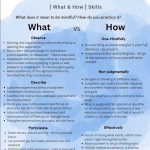
The skills are broken into two distinct but related categories:
“What” Skills: These tell you what to do. (Observe, Describe, Participate)
“How” Skills: These tell you how to do it. (Nonjudgmentally, One-Mindfully, Effectively)
Let’s break down exactly what that means for you.
The “What” Skills: Pinpointing Your Present Experience
The “What” skills are about learning to notice what is happening, both inside and outside of you, without immediately trying to change it. Think of yourself as a curious scientist gathering data about your own experience.
H3: Observe: Noticing Without Getting Hooked
Observing is the practice of tuning into your senses and internal world. You pay attention to sights, sounds, smells, and physical sensations. You also notice thoughts and emotions as they drift through your mind, like clouds passing in the sky.
The key is to just notice them without grabbing onto them, analyzing them, or pushing them away.
Instead of: “I’m so anxious about this presentation.”
Try Observing: “I notice my heart is beating quickly. I feel a tightness in my chest. I’m having the thought that I might mess up.” Quick Start: Set a timer for one minute. Close your eyes and simply observe all the sounds you can hear, near and far. Don’t label them as “good” (birdsong) or “bad” (traffic). Just let the raw sound data enter your awareness. That’s pure observation.
H3: Describe: Putting Words to Reality
Describing adds a label to what you observe. When you put a name to a feeling or a thought, you create a small but powerful space between you and the experience. This prevents you from becoming fused with it. You are the one experiencing anger; you are not anger itself.
This skill is about sticking to the facts.
A thought is not a fact. Instead of “I’m a failure,” describe it as, “I’m having the thought that I’m a failure.”
A feeling is a feeling. Instead of “This situation is awful,” describe it as, “I am feeling sadness” or “I am feeling frustrated.”
Case Snippet: The Power of a Pause
Sarah felt a wave of intense anger after a coworker took credit for her idea. Her immediate impulse was to send a scathing email. Instead, she paused and silently used the Describe skill: “I feel heat in my face. My jaw is clenched. I’m having the thought that what he did was completely unfair.” By describing the facts of her experience, she gave her wise mind a moment to catch up. She didn’t act on the anger; she simply acknowledged it. This allowed her to choose a much more effective, professional response later.
H3: Participate: Diving Fully into the Moment
Participation is the art of throwing yourself completely into what you are doing right now. It means becoming one with the activity, letting go of self-consciousness and the feeling of being a separate observer.
Think about a time you were so absorbed in a hobby, a conversation, or even a simple task that time seemed to disappear. That was participation. You can bring this to any activity.
When washing dishes: Feel the warm water on your hands. Notice the scent of the soap. See the shimmer of the bubbles. Hear the clink of the plates.
When talking with a friend: Listen with your whole being. Let go of planning your response and just absorb their words, their tone, their body language.
A common pitfall is the inner critic that pops up: “Am I doing this right? This feels weird.” The goal is to notice that thought (Observe), label it as just a thought (Describe), and gently guide your attention back to participating in the action itself.
The “How” Skills: Shaping Your Mindful Stance
If the “What” skills are the nouns and verbs of mindfulness, the “How” skills are the adverbs. They describe the attitude or posture you bring to the practice. You use these three skills simultaneously while you Observe, Describe, and Participate.
H3: Nonjudgmentally: Dropping the “Good” and “Bad” Labels
This is one of the most difficult yet most liberating DBT mindfulness techniques. To be nonjudgmental means to see things as they are, without adding a layer of evaluation. You let go of labels like good/bad, right/wrong, fair/unfair.
Pain is a fact of life; suffering is often the story we tell ourselves about the pain.
Judgment: “This back pain is awful. I can’t stand it. My whole day is ruined.” (This adds a layer of suffering).
Nonjudgmental Description: “I feel a sharp sensation in my lower back. The sensation increases when I bend over.” (This is just data).
Being nonjudgmental doesn’t mean you approve of or are passive about harmful situations. It means you see the reality of the situation clearly, unclouded by reactive emotion, which allows you to act more wisely.
H3: One-Mindfully: The Power of Singular Focus
One-mindfully is the direct antidote to modern multitasking. It means doing one thing at a time and giving it your full attention. When you are eating, just eat. When you are walking, just walk. When your mind wanders (which it will), you gently and firmly bring it back to that one thing.
Analogy: Think of your attention like a spotlight. Multitasking is like trying to wave that spotlight around a dark room, catching blurry glimpses of everything. One-mindfulness is planting that spotlight on one object, illuminating it with perfect clarity.
This is a skill that requires constant practice. Each time you notice your mind has drifted to your to-do list while you were supposed to be listening to your child, and you gently guide your attention back, you are building this mental muscle.
H3: Effectively: Choosing What Works
Being effective means doing what is necessary to achieve your goals in a situation, rather than acting on what feels emotionally justified or “right.” It’s about letting go of willfulness when it gets in your way.
Effectiveness asks the question: “Do I want to be right, or do I want to be effective?”
Case Snippet: The Traffic Jam Choice
Mark was stuck in bumper-to-bumper traffic and was going to be late for an important meeting. His “righteous” mind screamed at him to lay on the horn, curse the other drivers, and fume with frustration. He felt justified in being angry. But then he asked himself, “What is effective right now?” Honking would only increase his own stress and accomplish nothing. The effective action was to take a few deep breaths, accept the reality of the situation, and send a quick, calm text message letting the other person know he was running 15 minutes late. He chose what worked over what his raw emotion demanded.
Your Daily DBT Mindfulness Playbook
You don’t need to set aside an hour a day to see benefits. The power of these skills lies in integrating them into the life you’re already living.
Activity
How to Apply DBT Mindfulness Techniques
Morning Coffee/Tea (5 mins)
One-Mindfully: Just drink your coffee. No phone, no news. Observe: Notice the warmth of the mug, the aroma, the steam. Describe: Silently label the taste (“bitter,” “rich,” “sweet”). Participate: Fully immerse yourself in the simple act of sipping.
Daily Commute/Walk (10 mins)
Participate: Feel your body moving. Observe: Notice the sensation of your feet hitting the pavement. Observe the sights and sounds around you without judgment. Effectively: Use this time to ground yourself, not to ruminate on the workday ahead or behind.
Eating Lunch (15 mins)
One-Mindfully: Put your phone away. Describe: What are the textures? The flavors? The colors? Nonjudgmentally: Let go of any thoughts about whether you “should” be eating this food. Just experience it.
Difficult Conversation
Observe: Notice your own emotional and physical reactions. Describe: Label your feelings internally (“I’m feeling defensive”). Participate: Practice mindful listening-hear their words without planning your rebuttal. Effectively: Focus on the goal of mutual understanding, not “winning” the argument.
Quick Answers to Common Hurdles
It’s normal to run into challenges when you start. Here are some of the most common questions and how to navigate them.
Q: My mind wanders constantly. Am I failing at this?
A: Absolutely not. You are succeeding. The practice is not about having a perfectly still mind; it’s about the moment you notice your mind has wandered. That moment of noticing is mindfulness. Every time you gently guide your attention back to your breath or your task, you are doing a rep at the mental gym and strengthening your focus. The goal isn’t to stop thoughts, but to stop being carried away by them.
Q: Isn’t being ‘nonjudgmental’ just ignoring bad behavior or being a doormat?
A: This is a crucial distinction. Being nonjudgmental is not about approval; it’s about clarity. Judging a situation as “terrible and unfair” often fuels feelings of helplessness or rage, which can lead to ineffective actions. Observing the facts (“That person’s comment was inaccurate and it caused harm”) allows you to see the situation clearly so you can decide on the most effective response. You can act to change a negative situation without being consumed by the judgment of it.
Q: How is this different from regular meditation?
A: While these skills are rooted in meditative traditions, DBT frames them as active, portable skills to be used in the chaos of everyday life—not just on a quiet cushion. The “What” and “How” framework provides a highly structured and practical approach that is especially helpful when you’re in emotional distress. It gives you a specific set of instructions to follow when your mind is spinning out of control.
Q: How long does it take to see benefits from these techniques?
A: You might feel a small sense of relief or calm after your very first five-minute practice. For more lasting change, consistency is key. The National Center for Complementary and Integrative Health (NCCIH) notes that mindfulness practices can help reduce symptoms of anxiety, stress, and depression. Over time, as studies show, this practice can literally change the function and structure of your brain, particularly in areas tied to attention and emotion regulation.
Start with One Skill, One Moment
You don’t need to become a mindfulness master overnight. The goal is to start reclaiming the estimated 95% of life that most of us spend on autopilot. The journey begins with a single, simple step.
Here is your challenge: For the next 24 hours, choose just one routine activity. It could be brushing your teeth, washing your hands, or walking to your car.
For those two minutes, commit to doing it one-mindfully. Bring your full attention to it. Observe the sensations. Describe them in your mind. Participate fully. When your mind wanders, gently bring it back.
That’s it. That’s the first step. You are training your brain to be where your body is—fully alive and present in your own life.
I am a writer specializing in health and lifestyle, committed to delivering well-researched, engaging, and insightful content. With a keen eye for trends and a deep understanding of health, presenting and exploring topics ranging from nutrition and mental health to sustainable living. This writing is solely intended to educate, inspire, and empower readers to live a healthier, more balanced life.