You’ve carefully planned a group session, but when you start the mindfulness exercise, you feel the disconnect. Some members are fidgeting, others look bored, and one seems to be getting more agitated, not less. This is a common frustration, but it’s often because generic mindfulness doesn’t address the core needs of a group struggling with emotional intensity. This is where dbt mindfulness exercises for groups, rooted in Dialectical Behavior Therapy, offer a more structured and effective path forward, turning scattered attention into shared presence.
At a Glance: What You’ll Gain
The DBT Mindfulness Framework: Understand the core “What” and “How” skills that make DBT unique and powerful for groups.
Three Ready-to-Use Exercises: Get step-by-step instructions for group exercises designed to build awareness, participation, and non-judgment.
A Practical Session Blueprint: Learn how to structure a 60-minute, DBT-informed group session that flows smoothly and feels safe.
Expert Facilitation Tips: Discover how to handle common challenges like distress, resistance, and distractions with skill and compassion.
Clear Answers to Tough Questions: Get straight answers to the questions that come up when leading these sensitive and powerful groups.
Why DBT Mindfulness Is More Than Just Group Meditation
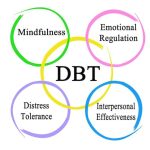
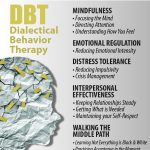
Developed by Dr. Marsha Linehan in the late 1980s, Dialectical Behavior Therapy (DBT) was initially designed to help individuals managing intense, overwhelming emotions. Mindfulness is the foundational module of DBT because it’s the skill that makes all the others—Distress Tolerance, Emotion Regulation, and Interpersonal Effectiveness—possible.
In a group context, DBT mindfulness isn’t about achieving a perfectly silent, blissful state together. It’s about building a collective capacity to stay present with reality as it is, even when it’s uncomfortable. It teaches group members how to pay attention and what to pay attention to, creating a shared language for inner experiences.
This structured approach fosters a unique kind of group cohesion. Instead of just meditating side-by-side, members are actively practicing skills that build empathy and validation. They learn to observe their own urges to judge or tune out, which directly translates to how they interact with others in the group. While DBT provides this specific framework, these skills can complement many other practices. For a wider range of ideas to build engagement, Read our fun group mindfulness guide.
The Core of the Practice: Mastering the “What” and “How” Skills
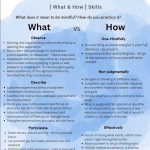
The genius of DBT mindfulness lies in its simplicity. It breaks the often-abstract concept of “being present” into six concrete skills that you can teach, practice, and master as a group.
The Three “What” Skills: Taking Hold of Your Mind
These skills are the actions of mindfulness—they are what you do when you are being mindful.
Observe: This is the practice of simply noticing sensations, thoughts, and feelings as they come and go, without trying to push them away or hold onto them. Think of it as sitting on a riverbank and watching leaves float by without jumping into the water to grab them. In a group, you can guide members to simply observe the feeling of their breath, the ambient sounds in the room, or a tingling sensation in their hands.
Describe: This skill involves putting words to what you observe. It’s a practice of non-judgmental labeling. For example, instead of, “I’m having an awful, anxious thought,” the description is, “A thought of worry is present.” This creates a bit of space between the person and their experience. In a group, you can prompt, “Silently label the next emotion you notice,” or “Describe the physical sensation in your shoulders right now.”
Participate: This is the skill of throwing yourself completely into the current moment’s activity. It’s about being fully present, without self-consciousness. When you are participating, you are no longer an observer of the moment—you are the moment. A group exercise could be as simple as mindfully sipping a glass of water, fully experiencing the temperature, taste, and sensation of swallowing.
The Three “How” Skills: The Mindful Stance You Take
These skills describe the posture or attitude you bring to the “What” skills. They are how you observe, describe, and participate.
Non-Judgmentally: This is the cornerstone of a safe group environment. It means seeing things as they are, without adding a layer of evaluation (good/bad, right/wrong, fair/unfair). As a facilitator, you model this by accepting all member contributions and gently guiding the group to notice their own judgments as just another thought to observe.
One-Mindfully: In a world of multitasking, this is the radical act of doing one thing at a time. When you are listening to a group member share, you are just listening—not planning your response, not checking the time, not thinking about your grocery list. This skill is profoundly powerful for building genuine connection.
Effectively: DBT is a pragmatic therapy. The skill of effectiveness is about focusing on what works to achieve your goals. It means letting go of being “right” in favor of being effective. In a mindfulness context, it might mean choosing to bring your attention back to your breath for the tenth time (because that’s the goal of the practice) instead of getting frustrated that your mind keeps wandering (which is ineffective).
Putting It Into Practice: 3 Powerful DBT Mindfulness Exercises for Groups
Here are three exercises designed specifically to teach and reinforce the “What” and “How” skills in a group setting.
1. The “What & How” Skills Stone Exercise
This simple, tactile exercise is excellent for introducing the core concepts in a tangible way.
Goal: To practice observing, describing, and non-judgment.
Materials: A unique, small stone or object for each participant.
Steps:
Distribution (2 mins): Pass around a bag of stones and ask each person to choose one without overthinking it.
Observe (3 mins): Instruct the group to close their eyes or lower their gaze. Guide them to observe the stone using only their sense of touch. Prompt them: “Notice the weight in your palm. Notice the texture—is it smooth, rough? Notice the temperature.”
Describe (3 mins): Ask them to open their eyes and continue observing the stone, this time adding the skill of describing. Prompt them: “Silently in your mind, put words to what you see. ‘This stone is gray with white spots.’ ‘This edge is sharp.’ Notice any judgments that arise, like ‘This is an ugly stone,’ and just label them: ‘judgment.'”
Share (5-10 mins): Go around the circle and invite each person to share one non-judgmental description of their stone. This isn’t about telling a story; it’s about the practice of neutral description.
2. Mindful Listening and Reflecting Dyads
This exercise directly targets one-mindful participation and builds critical interpersonal skills.
Goal: To practice one-mindful listening and experience being fully heard.
Steps:
Pair Up (1 min): Ask participants to form pairs. Designate one person as Speaker A and the other as Speaker B.
Speaker A Shares (3 mins): Give Speaker A a low-stakes prompt, such as, “Share about a simple moment of comfort or joy from the past week.” Instruct Speaker B to listen one-mindfully—no interrupting, no planning a response, just absorbing the words with full attention.
Speaker B Reflects (2 mins): When the time is up, Speaker B reflects back what they heard. They should not add their own story or advice. They can start with, “What I heard you say was…” This validates the speaker’s experience.
Swap Roles (6 mins): Repeat the process with Speaker B sharing and Speaker A listening and reflecting.
Group Debrief (5 mins): Bring the group back together. Ask: “What was it like to just listen? What was it like to be heard without interruption?”
A Quick Case Snippet: In a skills group for young adults, a member named Alex had a breakthrough during this exercise. “I realized I’ve never actually listened to anyone in my life,” he said. “I’m always just waiting for my turn to talk. For the first time, I felt like I was actually with the other person.” This single exercise shifted the group’s dynamic toward deeper empathy.
3. Walking with Wise Mind Meditation
This exercise integrates physical movement with the core DBT concept of “Wise Mind”—the synthesis of logical “Reasonable Mind” and feeling-based “Emotion Mind.”
Goal: To practice mindfulness of body sensations and connect to an inner sense of wisdom.
Steps:
Set the Stage (2 mins): Ask the group to stand in a circle with enough space to take a few slow steps in place or around the room.
Reasonable Mind (2 mins): Ask them to walk very slowly and bring their attention to the facts. “Notice the hard floor beneath your feet. Describe the sensation of your sock on your skin. Notice the temperature of the air.” This is “Reasonable Mind.”
Emotion Mind (2 mins): Now, guide them to notice any feelings that arise. “Is there any anxiety about walking in front of others? Is there boredom? Just notice the feeling as a wave of energy in your body.” This is “Emotion Mind.”
Wise Mind (4 mins): Finally, guide them to find the synthesis. “Now, see if you can hold both at once—the feeling of the floor and the feeling of the emotion. Find that quiet, centered place within you that acknowledges both. This is Wise Mind. From this place, simply walk. Just experience the simple, profound act of walking.”
Reflect (5 mins): Allow a few minutes for silent reflection or optional sharing about the experience of finding that “Wise Mind” space.
Your Blueprint for a DBT-Informed Group Session
A clear structure helps create a predictable, safe container for the group to do its work. While flexible, a reliable flow reduces anxiety and allows members to engage more fully.
Here is a sample 60-minute structure:
Phase
Time
Activity & Purpose
Opening & Grounding
10 mins
Welcome & Check-in: A brief welcome, confidentiality reminder, and a quick check-in (e.g., “Share one word for how you’re arriving today”). Grounding: Lead a 3-minute Mindful Breathing exercise to land in the room together.
Skills Introduction
15 mins
Teach a Micro-Skill: Introduce one “What” or “How” skill. Use a metaphor, a whiteboard drawing, or a personal example. Keep it short, clear, and interactive. Ask, “Where have you seen this before?”
Experiential Practice
20 mins
Lead the Main Exercise: Guide the group through one of the exercises above (e.g., Stone Meditation, Listening Dyads). Use a calm, slow voice and invitational language (“I invite you to notice…”).
Group Processing
10 mins
Share & Validate: Open the floor for sharing. Use non-judgmental prompts like, “What did you notice?” or “What was that experience like for you?” Actively validate members’ experiences (“That makes sense.”).
Closing
5 mins
Summarize & Close: Briefly summarize the skill practiced. End with a simple, unifying practice like a moment of shared silence or asking each person to think of one thing they are grateful for.
Quick Answers to Common Facilitator Questions
Q: What if a group member becomes highly distressed during an exercise?
A: Your first job is to ensure safety and provide validation. Calmly say, “It sounds like this is bringing up something really painful for you. That makes complete sense.” Offer them a choice to pause the exercise and use a distress tolerance skill (like holding an ice cube or stepping out for a moment of fresh air). Reassure them it’s a sign of courage to notice their limit, not a failure. Q: How do I handle someone who insists, “This mindfulness stuff doesn’t work for me”?
A: Practice non-judgment yourself. Thank them for their honesty—it’s valuable data. Get curious instead of defensive. Ask, “Can you tell me more about what the experience is like when you try?” Often, they believe the goal is to have no thoughts, so they feel they are failing. You can re-teach that the goal is simply to notice the mind wandering and gently bring it back. DBT is all about finding what is effective for that individual. Q: Can I use these exercises if I’m not a certified DBT therapist?
A: Yes, with an important clarification. These foundational mindfulness skills are universally beneficial and can be used by coaches, teachers, and wellness facilitators to promote connection and self-awareness. However, you must be transparent about your scope. If you are not a licensed therapist, you are not providing DBT therapy. You are facilitating DBT-informed mindfulness exercises for general well-being. Q: My group is very chatty and gets off-topic easily. How do I gently bring them back?
A: Validate the energy first. “I love the connection and energy in the room right now.” Then, gently redirect. “For the purpose of our practice, I’m going to invite us to bring our focus back, one-mindfully, to the exercise.” This honors their connection while maintaining the structure needed for skill-building.
From Theory to Action
Leading dbt mindfulness exercises for groups is less about achieving perfection and more about creating a space for authentic, shared practice. It’s about building a community that can learn to observe reality, describe it without judgment, and participate in life more fully, together. The structure and skills of DBT provide a powerful container to do just that.
Your first step doesn’t have to be a full-blown session. This week, try introducing just one of the “How” skills—non-judgment—into your group’s opening check-in. Ask each member to share one thing about their week and practice describing it without adding labels like “good,” “bad,” “amazing,” or “terrible.” Simply have them state the facts. Notice the shift in the room. That small change is the beginning of a profound practice.
I am a writer specializing in health and lifestyle, committed to delivering well-researched, engaging, and insightful content. With a keen eye for trends and a deep understanding of health, presenting and exploring topics ranging from nutrition and mental health to sustainable living. This writing is solely intended to educate, inspire, and empower readers to live a healthier, more balanced life.