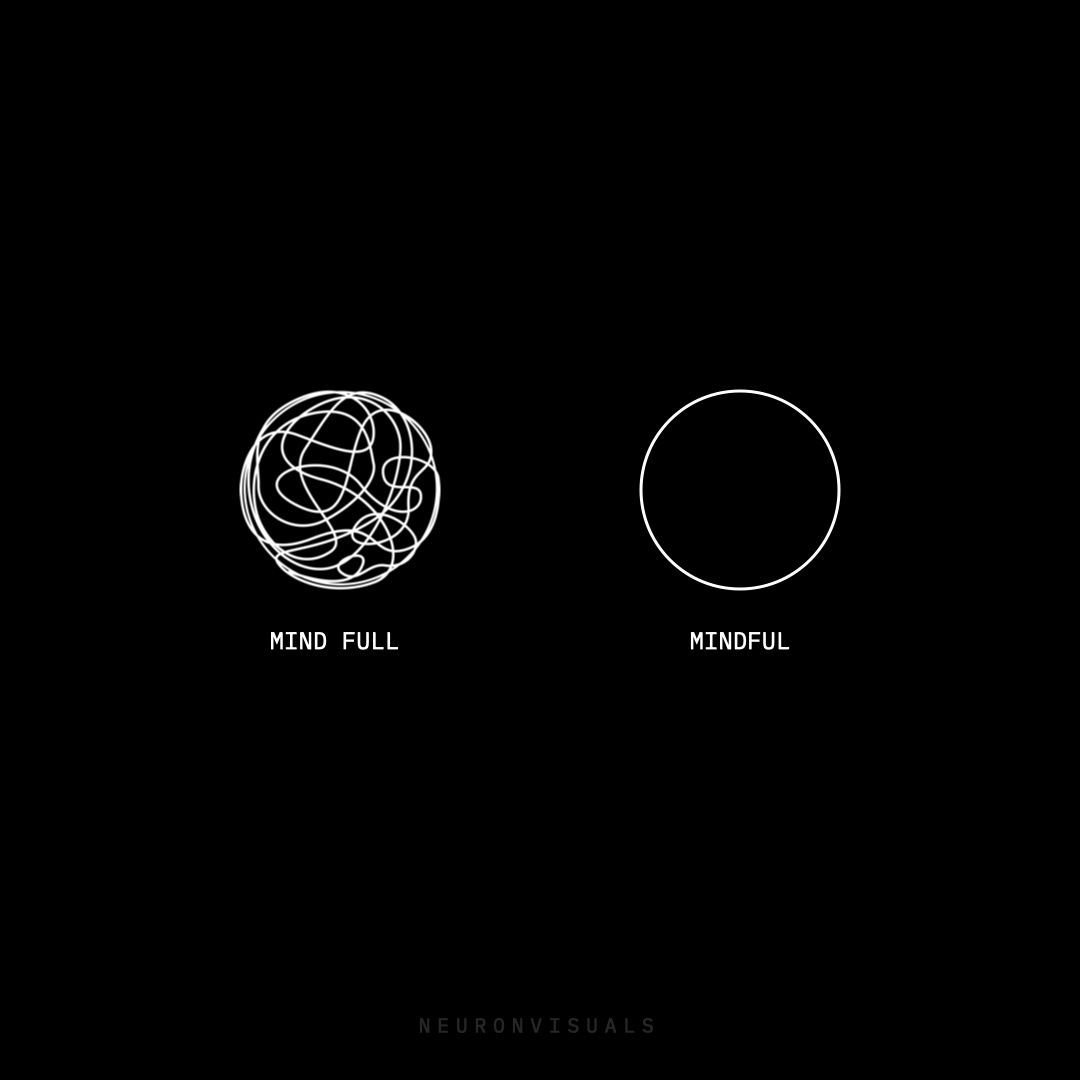
Does your brain feel like it has too many tabs open? You’re trying to focus on a task, but you’re also mentally replaying a conversation from yesterday, worrying about a deadline next week, and making a grocery list. This constant mental chatter is the core difference in the battle of mindful vs mind full. A mind that is full is a chaotic storm of past regrets and future anxieties. A mindful mind, however, is a calm, clear space where you can think, feel, and act with intention.
It’s not about emptying your mind; it’s about learning how to manage the traffic. This guide is your practical roadmap to shifting from a state of overwhelming noise to one of focused peace.
Pinpoint the Symptoms: Learn to recognize the subtle signs that your mind is “full,” from constant multitasking to heightened emotional reactivity.
Understand the “Why”: Discover the simple brain science behind stress and focus, and see how mindfulness physically reshapes your brain for the better.
Master Quick-Shift Techniques: Get step-by-step instructions for three exercises you can use anywhere, anytime to move from overwhelmed to present in under five minutes.
Apply It to Real Life: Find out how to integrate mindfulness into your workday, relationships, and daily routines without adding another item to your to-do list.
What Does a “Mind Full” Brain Actually Feel Like?
We often praise busyness, but living with a “mind full” brain is exhausting. It’s more than just having a lot on your plate; it’s a state where your internal world is fragmented and perpetually in overdrive. You’re physically present, but your mind is somewhere else entirely.
This state shows up in a few common ways:
The Constant Multitasker: You’re writing an email while on a video call, simultaneously thinking about what to make for dinner. The result? Three tasks done poorly, with a side of mounting stress because you feel unproductive.
The Mental Time Traveler: Your focus is rarely on the now. Instead, you’re stuck in a loop, replaying a past mistake or endlessly pre-planning for a future scenario that may never happen. This leaves you feeling disconnected from your actual life as it unfolds.
The Emotional Amplifier: With your brain’s resources drained by constant noise, your emotional regulation weakens. A minor inconvenience, like a slow driver, can trigger a disproportionate wave of anger or frustration.
The distinction between a “mind full” state and a “mindful” one is about where your attention lives.
| Mind Full (The Default State) | Mindful (The Trained State) |
| :— | :— |
| Focus: Past and future | Focus: The present moment |
| Internal State: Chaotic, noisy, fragmented | Internal State: Calm, clear, unified |
| Approach: Judgmental, critical (“I can’t believe I did that.”) | Approach: Observant, non-judgmental (“I am noticing a feeling of regret.”) |
| Result: Stress, anxiety, burnout, reactivity | Result: Peace, clarity, resilience, responsiveness |
A mind full of clutter leaves you feeling like a passenger in your own life, yanked around by every stray thought and worry. A mindful approach puts you back in the driver’s seat.
The Science Behind the Noise: Why Your Brain Gets Stuck in Overdrive
Your brain isn’t static; it’s constantly being shaped by your habits and thoughts. This ability to change, known as neuroplasticity, is the key to understanding why moving from “mind full” to “mindful” is not just a nice idea—it’s a biological upgrade.
Think of two key players in your brain:
The Amygdala (The Smoke Detector): This is your brain’s ancient alarm system. It’s designed to detect threats and trigger the “fight or flight” response, flooding your system with stress hormones like cortisol. In a “mind full” state, this alarm is on a hair-trigger. An ambiguous email from your boss or a critical comment can feel like a genuine threat, keeping you in a low-grade state of chronic stress.
The Prefrontal Cortex (The CEO): This is the more evolved part of your brain, responsible for rational thinking, emotional regulation, and focused attention. It’s the part that can look at the amygdala’s alarm and say, “Thanks, but it’s just an email. We’re safe.”
When your mind is perpetually full, the smoke detector (amygdala) is screaming all day long, and the CEO (prefrontal cortex) is too overwhelmed to regain control. Research shows that consistent mindfulness practice does two amazing things: it actually shrinks the grey matter density in the reactive amygdala while strengthening the connections in the thoughtful prefrontal cortex.
You are literally training your CEO to be a better, calmer leader. Understanding this fundamental dynamic is the first step toward lasting change. The broader question of Is your mind full or mindful? serves as a powerful framework for beginning this journey toward real peace.
Your Practical Playbook: 3 Techniques to Shift from Full to Mindful
Knowing the difference between mindful vs mind full is one thing; having the tools to make the shift is another. These three techniques are simple, require no special equipment, and are designed to be used in the middle of a busy day.
Technique 1: The 30-Second “Anchor Breath” Reset
When you feel your thoughts spiraling, your breath is your most reliable anchor to the present moment. This isn’t about deep, complicated breathing; it’s about pure focus. How to do it:
Pause: Stop what you’re doing. If you can, close your eyes.
Inhale: Breathe in slowly through your nose for a count of four. Focus only on the sensation of the air entering your nostrils.
Hold: Gently hold your breath for a count of four. Notice the stillness.
Exhale: Breathe out slowly through your mouth for a count of six. Feel the tension leaving your body with the air.
Repeat: Do this three to five times. Why it works: This simple act breaks the mental feedback loop of stress. The slightly longer exhale stimulates the vagus nerve, which activates your parasympathetic nervous system—your body’s natural “rest and digest” mode—telling your brain you are safe.
Technique 2: Single-Tasking with Intention (The ‘Mono-Task’ Challenge)
Multitasking is a myth. What you’re actually doing is “task-switching,” rapidly toggling your brain’s attention, which is inefficient and drains mental energy. Reclaim your focus by intentionally single-tasking. How to do it:
Choose a Task: Pick one routine activity you usually do on autopilot, like making your morning coffee, brushing your teeth, or washing a dish.
Commit to One Sense: For the duration of that task, dedicate your full attention to it through one primary sense.
Making coffee? Focus on the smell of the grounds, the sound of the water, the warmth of the mug.
Brushing your teeth? Focus on the feeling of the bristles, the taste of the paste.
Washing a dish? Focus on the sensation of the warm water on your hands, the texture of the sponge.
Gently Redirect: When your mind wanders (and it will), gently and without judgment, guide it back to the sensory experience of your task. Why it works: This exercise is like a bicep curl for your brain’s “attention muscle.” It retrains your prefrontal cortex to hold its focus, making it easier to stay on task during more complex activities later.
Technique 3: The “Name It to Tame It” Journaling Practice
Thoughts and emotions can feel overwhelming when they are a tangled, unnamed mess. This five-minute practice creates clarity and distance, putting you back in control. How to do it:
Brain Dump (3 Minutes): Open a notebook and for three minutes, write down everything swirling in your mind. Don’t filter it, don’t worry about grammar. Just get it out.
Label (2 Minutes): Read back through what you wrote. With a different colored pen, label the thoughts and feelings. Use simple, non-judgmental tags like:
“Worry about work project”
“Planning for the weekend”
“Annoyance about traffic”
“Replaying a conversation”
“Feeling of sadness” Why it works: The act of labeling moves the activity from the reactive, emotional parts of your brain to the logical, observing prefrontal cortex. You are no longer in the storm; you are watching it. This simple act of observation diminishes the emotional charge of the thoughts.
Weaving Mindfulness into a Life That’s Already Busy
The biggest obstacle for many is the belief that mindfulness is another thing to add to an already packed schedule. The secret is not to add more, but to infuse what you’re already doing with a new quality of attention.
At the Office: The Mindful Micro-Break
Instead of scrolling through your phone during a two-minute break, try this. Look away from your screen and find something non-digital to observe. It could be a plant on your desk, the clouds moving outside the window, or the pattern of the wood grain on your table. Simply notice the colors, textures, and light for 60 seconds without judgment. This rests your brain far more effectively than a social media feed.
Real-World Snippet: A marketing manager, feeling overwhelmed before a high-stakes client presentation, excused herself to the restroom. Instead of reviewing her notes again, she spent 90 seconds doing the “Anchor Breath” reset. She returned to the conference room feeling grounded and centered, allowing her to deliver her pitch with clarity and confidence instead of anxiety.
In Your Relationships: The Power of Mindful Listening
How often in a conversation are you truly listening, versus just waiting for your turn to speak? Mindful listening is the practice of offering your full, undivided attention. When someone is talking, notice their words, their tone, and their body language. When your mind starts formulating a response, gently guide it back to simply hearing them. You’ll connect more deeply and often find that problems resolve themselves when people feel truly heard.
During Daily Routines: From Autopilot to Awareness
Your commute, your shower, your walk to the mailbox—these are all opportunities for mindfulness. Choose one routine and switch off the autopilot. Turn off the podcast for the first five minutes of your drive and notice the feeling of your hands on the steering wheel. In the shower, feel the sensation of the water on your skin. These small moments of presence accumulate, building a stronger foundation of mindfulness over time.
Quick Answers to Common Roadblocks
As you start practicing, questions and doubts are normal. Here are a few common ones.
Q: Isn’t mindfulness just about clearing your mind of all thoughts?
A: This is the most common myth. Mindfulness isn’t about stopping your thoughts; that’s impossible. It’s about changing your relationship with them. The goal is to notice your thoughts as they arise without getting swept away. Think of yourself sitting on a riverbank watching leaves (your thoughts) float by, rather than jumping into the river and being carried away by the current.
Q: I tried meditating, and my mind was even busier! Am I doing it wrong?
A: No, you’re doing it right! This is a sign of progress. It doesn’t mean your mind is suddenly busier; it means you are finally becoming aware of how busy it has been all along. The practice isn’t to have a quiet mind. The practice is to notice when your mind has wandered and, with kindness, gently guide it back to your anchor (like your breath). Every time you do that, you’re strengthening your mindfulness muscle.
Q: How long does it take to see real benefits?
A: You can feel the benefit of a single mindful breath in the moment—it can instantly reduce a spike of stress. For more lasting changes, consistency is key. Neuroscientific studies show that as little as 10 minutes of daily practice over several weeks can create measurable changes in brain structure and function, leading to improved focus, reduced anxiety, and greater emotional resilience. But don’t get hung up on the clock; focus on the practice itself.
Your First Step Today: Choose One Small Act of Mindfulness
The journey from a mind that is constantly full to one that is mindfully present doesn’t happen overnight. It happens one breath, one moment, one intentional choice at a time. A “mind full” brain is stuck in a reactive, exhausting cycle. A “mindful” brain is responsive, resilient, and ready for whatever comes next.
Don’t try to do everything at once. Your only task today is to choose one thing from this guide and try it.
Set a timer for 30 seconds and practice the Anchor Breath right now.
Decide to single-task while you make your next cup of coffee.
Practice mindful listening during your next conversation.
The goal is not perfection; it’s presence. Start there, and you’ve already taken the most important step.
I am a writer specializing in health and lifestyle, committed to delivering well-researched, engaging, and insightful content. With a keen eye for trends and a deep understanding of health, presenting and exploring topics ranging from nutrition and mental health to sustainable living. This writing is solely intended to educate, inspire, and empower readers to live a healthier, more balanced life.