When a wave of intense emotion hits, the world can feel like it’s shrinking to that single feeling—anger, fear, or profound sadness. The standard advice to “just calm down” or “be more mindful” often feels useless in those moments. This is where dbt mindfulness offers a lifeline, not by teaching you to suppress emotions, but by giving you a practical, skill-based framework to navigate them without being swept away. It’s a structured approach that builds the crucial space between an emotional trigger and your reaction, giving you the power to choose your response.
At a Glance: Key Takeaways
Builds a “Pause Button”: DBT mindfulness skills create a mental space between feeling an emotion and acting on it, which is the foundation of emotional regulation.
Reduces Suffering, Not Feelings: The goal isn’t to eliminate emotions but to stop judging them, which adds a secondary layer of pain like shame or guilt.
Connects Awareness to Action: These skills help you see a situation clearly and then choose the most effective course of action, rather than one driven by momentary impulse.
Evidence-Based Results: Research confirms that practicing these skills significantly reduces emotional distress and improves psychological well-being, particularly for those with intense emotions.
You’ve probably heard it before: “Just be in the moment.” For someone struggling with emotional dysregulation, this advice can feel dismissive or impossible. When your internal world is a storm of painful thoughts and intense physical sensations, the “present moment” is the last place you want to be.
This is the critical difference with the DBT approach. It acknowledges that the present can be painful. Instead of offering a platitude, Dialectical Behavior Therapy provides a set of concrete skills to manage that pain. It treats mindfulness not as a vague state of being, but as an active, behavioral skill you can practice and improve, just like learning an instrument.
Think of it like learning to swim. Someone shouting “just float!” from the shore isn’t helpful when you’re thrashing in the water. You need specific instructions: how to position your body, how to breathe, how to kick. DBT mindfulness provides those instructions for your inner world.
The Core Connection: How DBT Mindfulness Rewires Your Emotional Responses
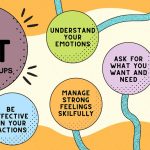
At its heart, dbt mindfulness is about changing your relationship with your own mind. It trains you to become an observer of your thoughts and feelings rather than a prisoner to them. This shift is what allows for profound improvements in emotional regulation.
From Reactive to Responsive: The Power of the Pause
Emotional dysregulation often involves a near-instantaneous leap from trigger to reaction. A critical comment leads to an outburst; a feeling of anxiety leads to avoidance. There’s no space to think.
Mindfulness skills, particularly Observe, create that space. By practicing noticing your internal state—a hot feeling in your chest, a thought that you’re a failure, an urge to yell—you learn to see these as temporary events, not absolute truths that demand immediate action. This pause is everything. In that space, you regain the ability to choose.
Building Your “Wise Mind”
DBT posits that we have two primary states of mind: the “Reasonable Mind” (cool, rational, task-focused) and the “Emotion Mind” (hot, reactive, mood-dependent). Acting from either extreme is often ineffective. Yelling at your partner is an “Emotion Mind” action. Suppressing your feelings and giving a cold, logical analysis of a conflict is a “Reasonable Mind” action.
The goal of DBT mindfulness is to access and act from “Wise Mind”—the integration of both. It’s the place of inner wisdom where you acknowledge your emotions and also consider the logical consequences of your actions. It’s the parent who validates a child’s tantrum (emotion) while still holding a boundary (reason). Mindfulness is the path to finding that balanced, effective inner voice.
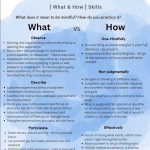
The “What” Skills: Your Toolkit for Seeing Clearly
DBT organizes the core mindfulness skills into two categories. The “What” skills are the actions you perform—they are what you do when you are being mindful.
Observe: Noticing Without Getting Hooked
This is the foundational skill. Observe means simply noticing sensations, thoughts, and feelings as they flow through you, like watching clouds drift across the sky. You don’t grab onto them, push them away, or analyze them. You just notice.
Mini-Example: You feel a surge of anger. Instead of immediately reacting, you Observe. You notice your jaw clenching, your face getting hot, and your thoughts racing. You just watch it happen inside you without judgment or action. You are observing the experience of anger.
Describe: Putting Words to the Experience
Once you can observe an internal experience, the next step is to label it with words. Describing is a factual, non-judgmental labeling of what you’ve observed. The act of naming an emotion has been shown to calm the amygdala, the brain’s alarm center.
Mini-Example: After observing the clenched jaw and hot face, you might silently Describe it: “A feeling of anger is in my body. I am having the thought that this is unfair.” You’re not saying “I’m an angry person” or “This is a terrible feeling.” You’re just stating the facts of your experience.
Participate: Engaging Fully in This Moment
Participate means throwing yourself completely into the current activity. It’s about being fully present, not halfway in while your mind is somewhere else. It’s the antidote to dissociation or endlessly ruminating on the past or future.
Mini-Example: You’re washing dishes but your mind is replaying an argument from yesterday. You catch yourself and decide to Participate. You focus entirely on the feeling of the warm water on your hands, the sound of the plates clinking, and the smell of the soap. You become one with the activity.
These three “What” skills are the fundamental actions of dbt mindfulness. To see how they fit into the complete framework of core skills, you can explore our guide to Master DBT mindfulness skills.
The “How” Skills: The Mindset That Makes It All Work
Practicing the “What” skills is only half the battle. The “How” skills are the attitudes or mindsets you bring to the practice. Without them, observing and describing can become another form of self-criticism.
Non-Judgmentally: Dropping the “Good” vs. “Bad” Labels
This is often the hardest and most impactful skill. We are constantly judging our experiences and, most painfully, our own emotions. We label anxiety as “bad,” joy as “good,” and anger as “unacceptable.” This judgment adds a second layer of suffering. First, there’s the pain of the emotion itself; second, there’s the pain of judging yourself for having it.
Practical Shift: Instead of thinking, “I shouldn’t be so anxious, what’s wrong with me?” try, “Anxiety is present. I notice thoughts of self-criticism arising.” See the difference? You are sticking to the facts without layering on shame or guilt.
One-Mindfully: The Antidote to Emotional Overwhelm
In a world that praises multitasking, DBT champions its opposite. One-Mindfully means doing one thing at a time with your full attention. When you’re emotionally overwhelmed, your mind is often jumping between a dozen worries, memories, and fears. This fragmentation fuels dysregulation.
Practical Shift: When you feel scattered and overwhelmed, deliberately choose to do one thing One-Mindfully. Make a cup of tea and focus only on that. Listen to a song and focus only on the music. This practice pulls your attention back from the chaos and anchors it to the stability of a single focus.
Effectively: Doing What Works to Reach Your Goals
Mindfulness isn’t about being passive. The skill of Effectiveness connects your present-moment awareness to skillful action. It’s about asking yourself: “In this situation, what is the most effective thing I can do to get closer to my goals?” This may be different from what your emotions are screaming at you to do.
Practical Shift: Your partner says something that hurts you. Your “Emotion Mind” urges you to yell and say something hurtful back. But your goal is a healthy relationship. Acting Effectively might mean saying, “When you said that, I felt hurt. Can we talk about it?” You are choosing the action that works over the action that simply releases a momentary impulse.
A Practical Playbook for Integrating DBT Mindfulness
Theory is one thing; application is another. Here’s how these skills come together to regulate a real-life emotional spike.
Scenario: You receive a blunt email from your boss that feels critical, and you immediately feel a surge of panic and shame.
Old Reaction (Without Skills)
DBT Mindfulness Response (Step-by-Step)
1. Observe:
2. Describe:
3. Non-Judgmentally:
4. One-Mindfully:
5. Effectively:
This process might take five minutes, but it completely changes the outcome. You moved from being a victim of your emotional reaction to being an active, skillful manager of your inner state.
Quick Answers to Common Questions
Is this just another word for meditation?
Not exactly. While formal meditation is a great way to practice, dbt mindfulness is about applying skills in your everyday life, especially during stressful moments. It’s less about sitting on a cushion in silence and more about being mindful while you’re in a difficult conversation, stuck in traffic, or feeling a craving.
How long does it take to see results?
It’s a practice, not a magic pill. However, many people report feeling small shifts in their ability to pause and observe fairly quickly. According to research studies on DBT, consistent practice leads to significant decreases in clinical symptoms and distress and measurable improvements in emotional regulation skills over a matter of months.
What if I can’t stop judging my thoughts and feelings?
This is the most common challenge. The trick is to apply mindfulness to the judgment itself. When you notice a judgmental thought like, “I’m so stupid for feeling this way,” simply Describe it: “A judgmental thought is present.” You observe the judgment non-judgmentally. It’s a meta-skill that takes practice, but it’s the key to unhooking from self-criticism.
Can I learn these skills without being in formal DBT therapy?
While DBT is most effective when delivered by a trained therapist in its full format (especially for conditions like BPD), the core mindfulness skills are accessible to everyone. Reading books, using workbooks, and practicing the exercises on your own can build a powerful foundation for better emotional regulation and mental health.
Your First Step Toward Emotional Balance
Feeling motivated is great, but starting small is what builds lasting change. Don’t try to master all six skills at once. Instead, pick one and make it your focus for the next week.
A great place to start is with the Observe skill. For the next seven days, commit to this simple practice:
Three times a day, set a timer for 60 seconds. Stop what you are doing and just Observe.
Notice five things you can see in the room.
Notice three sounds you can hear.
Notice one sensation in your body (e.g., your feet on the floor, the air on your skin).
That’s it. No need to change or fix anything. The simple act of repeatedly pulling your attention back to the present moment is the first, most powerful step in building the muscle of mindfulness. You are training your brain to create that pause, and in that pause, you will find your power to choose.
I am a writer specializing in health and lifestyle, committed to delivering well-researched, engaging, and insightful content. With a keen eye for trends and a deep understanding of health, presenting and exploring topics ranging from nutrition and mental health to sustainable living. This writing is solely intended to educate, inspire, and empower readers to live a healthier, more balanced life.