It’s easy to feel like your mind is a browser with too many tabs open. When you try to focus on one thing, a dozen others pop up, demanding attention. A well-designed mindfulness handout acts as a guide, a simple tool to close those tabs and bring your awareness back to the only moment that truly exists: right now.
At a Glance: Your Takeaways
Understand the “Why”: Learn how a mindfulness handout moves theory into practice, helping you regulate emotions and sharpen focus.
Choose the Right Tool: Discover different types of handouts—for grounding, self-awareness, breathwork, and emotional processing—and identify which one fits your immediate needs.
Master Core Exercises: Get step-by-step instructions for foundational practices like the Five Senses Exercise and Square Breathing.
Apply It to Your Life: See how to use these tools in real-world scenarios, from managing workplace stress to navigating intense emotions.
Build a Sustainable Habit: Find practical tips for integrating mindfulness into your daily routine without it feeling like another chore.
Moving Beyond Theory: What Makes a Handout Effective?
Mindfulness isn’t about emptying your mind; it’s about paying attention to the present moment on purpose, without judgment. Research in neurobiology confirms that consistent practice can literally reshape the brain, improving emotional regulation and attention. A good mindfulness handout bridges the gap between knowing this and doing it.
It acts as a structured prompt, guiding you through a specific exercise when your mind feels too chaotic to do it alone. This is why these tools are cornerstones in therapeutic approaches like Dialectical Behavior Therapy (DBT) and Acceptance and Commitment Therapy (ACT). They provide a tangible starting point for developing self-awareness and emotional flexibility.
Find Your Anchor: Handouts for Grounding and Presence
When anxiety or panic sets in, your mind is usually racing into the future or replaying the past. Grounding exercises pull you back to the present by focusing your attention on your physical senses. They are your emergency brake for an overwhelmed mind.
The Five Senses Exercise (The 5-4-3-2-1 Method)
This is one of the most immediate and effective grounding techniques. It forces your brain to switch from abstract worry to concrete sensory input.
How to do it:
5 things you can SEE: Look around and slowly name five distinct objects. A blue pen. A crack in the ceiling. A dusty leaf on a plant. Don’t just list them; notice details.
4 things you can FEEL: Bring your attention to physical sensations. The texture of your jeans. The smooth surface of your desk. The slight breeze from a vent. The weight of your feet on the floor.
3 things you can HEAR: Listen closely for three distinct sounds. The hum of a computer. Distant traffic. Your own breathing.
2 things you can SMELL: What scents are in the air? The faint aroma of coffee? The clean scent of soap on your hands? If you can’t smell anything, imagine two of your favorite smells.
1 thing you can TASTE: Notice the taste in your mouth. Remnants of your last meal? Toothpaste? You can also take a sip of water and focus solely on its taste and temperature.
Case Snippet: Alex, a project manager, felt a panic attack coming on before a big presentation. His heart was pounding, and his thoughts were spiraling. He ducked into an empty office and used a “Five Senses” mindfulness handout he kept in his work bag. By methodically focusing on the clock on the wall, the feel of his wool blazer, and the hum of the lights, he anchored himself. Within minutes, his breathing slowed, and he could walk into the meeting with a clear head.
The goal isn’t to make the anxiety disappear forever, but to stop the runaway train of panic in its tracks. A simple handout can be your script when you can’t think of the words yourself. For more exercises like this, you can explore a collection of resources like these Download Free Mindfulness Worksheets.
Decode Your Inner World: Handouts for Self-Awareness
Mindfulness is also about getting to know yourself better. Handouts focused on self-awareness help you identify your thoughts, feelings, and motivations without getting entangled in them.
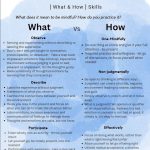
Distinguishing Mind Full vs. Mindful
One of the most foundational worksheets simply helps you identify your current mental state.
Mind Full: Characterized by a chaotic, cluttered mind. You’re likely multitasking, worrying about the future, ruminating on the past, and feeling overwhelmed.
Mindful: Characterized by a calm, focused mind. You are present in the moment, engaged with what you’re doing, and aware of your thoughts without being controlled by them.
A handout for this typically presents these two states side-by-side with checklists. By honestly assessing where you are, you create the awareness needed to shift from one state to the other.
The “Not-To-Do” List
We’re obsessed with productivity and to-do lists, but what about the things that actively drain our peace and focus? This powerful handout flips the script. It asks you to identify and commit to avoiding things across categories like:
Attention Hijackers: (e.g., Mindlessly scrolling social media for 30 minutes)
Stress Triggers: (e.g., Engaging in gossip at work)
Energy Drainers: (e.g., Saying “yes” to a request you don’t have time for)
Things Outside Your Control: (e.g., Worrying about what others think of you)
Creating this list is an act of self-compassion. It gives you permission to protect your mental energy.
The Power of the Breath: Handouts for Calming Your Nervous System
Your breath is a powerful, portable tool for influencing your physiological state. When you’re stressed, your breathing becomes shallow and rapid. By intentionally slowing it down, you signal to your nervous system that it’s safe to relax. Breathwork handouts provide a visual guide for these powerful exercises.
Square Breathing (Box Breathing)
This technique is used by everyone from Navy SEALs to therapists to manage stress and improve concentration. The four-part structure is easy to remember.
Inhale: Breathe in slowly through your nose for a count of 4.
Hold: Gently hold your breath for a count of 4.
Exhale: Breathe out slowly through your mouth for a count of 4.
Hold: Hold the exhale for a count of 4 before repeating.
A handout will often show a square, guiding you along each side as you complete the four steps. Repeating this cycle for just 2-3 minutes can significantly lower your heart rate and calm your mind.
Alternate Nostril Breathing
This yogic practice, known as Nadi Shodhana, is excellent for balancing the mind and body. It activates the parasympathetic nervous system—your body’s “rest and digest” mode.
Use your right thumb to gently close your right nostril.
Inhale slowly and deeply through your left nostril.
Close your left nostril with your ring finger, releasing your thumb from the right nostril.
Exhale slowly through your right nostril.
Inhale through the right nostril.
Close the right nostril, release the left, and exhale through the left.
This completes one round. A handout can be especially helpful at first to guide you through the sequence.
A Practical Playbook for Using Your Handout
Choosing the right mindfulness handout depends entirely on your goal. Use this simple guide to match the tool to the task.
If Your Goal Is…
A Great Handout to Try Is…
Why It Works
To calm immediate panic or anxiety
Five Senses (5-4-3-2-1)
It short-circuits anxious thought loops by forcing your focus onto concrete sensory data.
To improve daily focus and clarity
Mind Full vs. Mindful
It builds awareness of your mental state, which is the first step toward changing it.
To lower stress before a meeting
Square Breathing
The rhythmic pattern calms the nervous system and promotes a state of relaxed alertness.
To understand your emotions better
Feelings Wheel or Journal Prompts
It provides a vocabulary for your feelings, helping you identify and process them.
To stop self-sabotaging behaviors
My Not-to-do List
It makes you consciously aware of the habits that drain your energy and peace.
Best Practices for a Sustainable Routine:
Start Small: Don’t aim for a 30-minute session on day one. Try a 5-minute breathing exercise using a handout. Consistency beats intensity.
Link It to an Existing Habit: Practice your mindfulness handout right after you brush your teeth or while your coffee brews. This “habit stacking” makes it easier to remember.
Be Patient and Non-Judgmental: Your mind will wander. That’s what minds do. The practice is not about stopping thoughts but about gently noticing when you’ve wandered and guiding your attention back to the handout. Every time you do this, you’re strengthening your “mindfulness muscle.”
Quick Answers to Common Questions
Q: How do I know if I’m doing it right?
A: If you are intentionally paying attention to the exercise without judging yourself for getting distracted, you’re doing it right. There is no “perfect” state to achieve. The goal is the process of returning your focus, again and again. Q: What if I feel bored or restless while using a mindfulness handout?
A: That’s completely normal. Boredom and restlessness are just more things to be mindful of. Notice the sensation. Where do you feel it in your body? Acknowledge it (“Ah, there’s boredom”) and then gently guide your attention back to the exercise on the page. Q: Can a simple piece of paper really help with serious issues like anxiety or depression?
A: A mindfulness handout is a tool, not a cure. For serious mental health concerns, it should be used as a supplement to professional care from a therapist or counselor. However, these tools are highly effective for building the skills of emotional regulation and self-awareness that are foundational to managing conditions like anxiety and depression. They empower you to actively participate in your own well-being. Q: Isn’t this just overthinking? How is it different from worrying?
A: It’s the opposite. Worrying is getting lost in a chaotic storm of thoughts, usually about the future. Mindfulness is like being the calm, curious observer of that storm. You notice the thoughts (“There’s a worry about the deadline”) from a stable, grounded place without getting swept away by them.
Your First Step Toward Inner Peace
You don’t need a silent retreat or an hour of meditation to begin. All you need is a single piece of paper and the willingness to pay attention.
Start with one exercise. Print out a Square Breathing handout and try it the next time you feel a wave of stress at work. Use the Five Senses technique the next time you’re stuck in traffic and feeling agitated. Each time you use a mindfulness handout, you’re casting a vote for a more focused, calm, and present version of yourself. This isn’t about adding another task to your day; it’s about transforming the quality of the moments you already have.
I am a writer specializing in health and lifestyle, committed to delivering well-researched, engaging, and insightful content. With a keen eye for trends and a deep understanding of health, presenting and exploring topics ranging from nutrition and mental health to sustainable living. This writing is solely intended to educate, inspire, and empower readers to live a healthier, more balanced life.